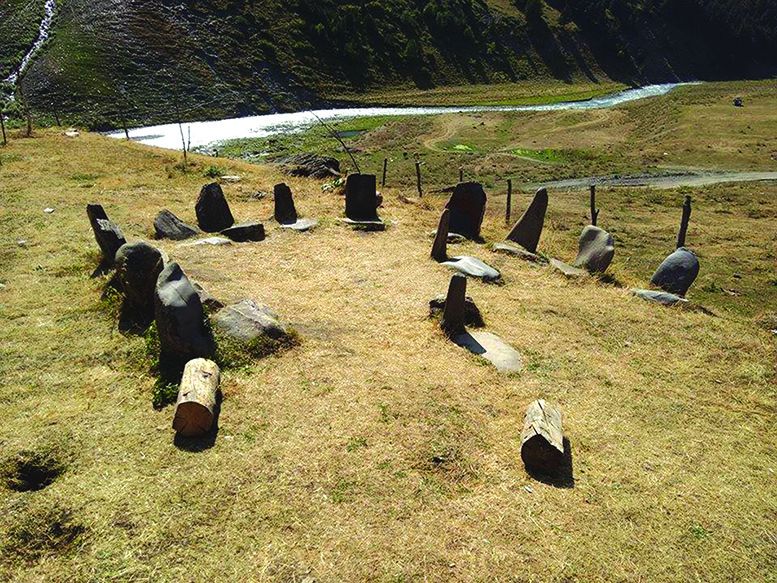
In the history of Georgian justice, there are many monuments of interesting legal proceedings of the formation of the legal culture of our country, among which "Dartlos Sabcheo" undoubtedly occupies a prominent place.
The customs of mountain law are a sign of the ancient judicial culture of Georgians, and in this regard, "Dartlos Sabcheo" has a unique historical significance, because the monument perfectly presents the format and peculiarities of legal proceedings, which today are considered as actual challenges of the legal systems of the modern world.
"Dartlos Sabcheo" is the most perfectly preserved monument among the legal proceedings monuments in Tusheti. The court consisting of elders in Mtashi has a long history, the creation of Dartlo Sabcheo is attributed to the XVI-XVII centuries.
In the village of Dartlo, at the "Sabcheo" located west of the church, all urgent, important and conciliatory issues for the village were discussed. 12 stone chairs were placed on the semi-circle for the elder judges. An oath was taken when discussing disputed issues.
Two additional stones were placed on "Sabcheo", on which the plaintiff and the accused stood. People were watching from afar. If the jurors doubted what the plaintiff or the accused said, then they had to swear on the cross of the icon door or on the grave of the ancestor. After that, the final decision would be made. Disobeying the decision was tantamount to blaspheming God.
The role and involvement of women was important in the life and organization of Georgian mountaineers, which is as old as community court. The mentioned fact is confirmed by the judgeship of the mountain jury court - often, the fate of a man was decided by female judges.
Not only in Dartlo, but in Tusheti in general, the court did not issue a death sentence, which is one of the key indicators of the justice system's humanity and respect for human dignity. The biggest punishment was excommunication from the village and community. However, the punished person was allowed to appeal to the village after years with a request to return. Judges were elected by the village, although it is not known whether this was a permanent or temporary duty. It is also important to note that in the 18th century, Anna, the daughter of Devdris Anta, the Tushi hero who fought against the Leks, was in charge of Dartlo Sabcheo. Accordingly, the monument historically confirms the fact that the centuries-old Georgian law and order and historical reality were based on the principles of gender equality that are relevant for modern society.
Why still 12 judges? - Different opinions can be expressed about this, however, some Georgian historians believe that it comes from worshiping the sun, since Georgia was the oldest sun worshiping country. Ancient astrologers also divided the sky into 12 zodiacs, which also revolve around the sun.
(Sources: Davitashvili G., Court Organization and Process in Georgian Customary Law, Tbilisi, 2004, 158-200; Azikuri N., Social Status of Women in Eastern Mtianeti, Proceedings of the International Scientific Conference "World and Gender", Tbilisi, 2017, 81-88; Tsotsanidze G., Ghelelauri G., Tusheti Guide-guide, Tbilisi, 2022, 395-406; https://www.supremecourt.ge/ka/news/qartuli-samartlis-dzeglebis-shesakheb-informatsia)
The opinions expressed in the article are those of the author and may not reflect the official position of LAWHUB.




discussion 0
to write a comment Sign in to your account. Anyone can read comments.
There are no comments yet - start a discussion.