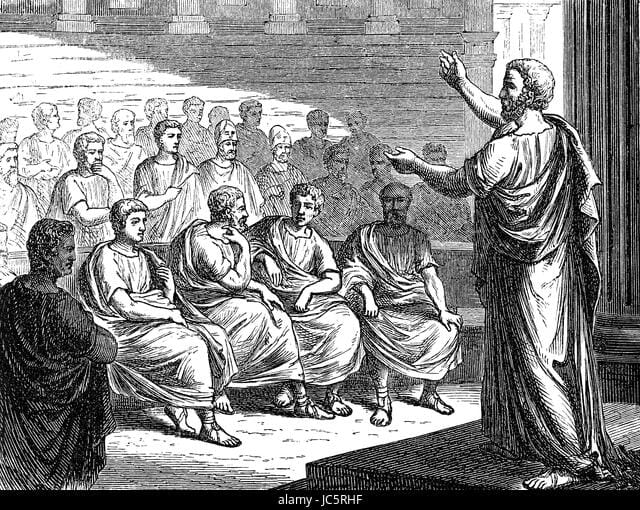
"Logographer" Translated from Greek, it means "composer of words". In modern terms, we may refer to him as a lawyer. In ancient Greece, the logographer was one of the most irreplaceable persons who was tasked with sorting out all the complex and complicated court cases, where it was necessary to arrange them in a proper order and to report the real facts in such a way that the essence of the case became clear to the judges, because in the Greek court of that time the words of the plaintiff and the defendant were of decisive importance. Such words were written by "logographers" and they received a very high salary for it. These above-mentioned reasons were the main source of the fact that they never lacked customers. However, I must mention here that despite their successful activities, they could not enjoy great respect among the people, since they were considered sellers of their beliefs.
The logographer was obliged to gather all the necessary materials for the preliminary investigation of the case, to indicate the court authority that should decide the case, to formulate the most appropriate form of the lawsuit and in some private cases to determine the size of the punishment himself. But his main duty was to write the speech. which the client learned by heart to recite in court. First of all, this is what made him different from the modern lawyer, who speaks on his own behalf and is not at all obliged to adhere to the personality of the client, while the logographer was forced to disguise his own creativity in every way and make his speech the client's own creation, for which he had to take into account the personal qualities of his client, his social status or mental outlook. In addition to private commissions, logographers also fulfilled public commissions: on the order of state institutions, they drew up words to be recited at solemn or jubilee ceremonies, religious or sports holidays.
The opinions expressed in the article are those of the author and may not reflect the official position of LAWHUB.




discussion 0
to write a comment Sign in to your account. Anyone can read comments.
There are no comments yet - start a discussion.